
 English
 中文简体
中文简体 русский
 日本語
日本語 Français
 Español
 عربى
عربىen
In the context of the global circular economy and efficient industrial waste utilization, metal resource recycling demands higher equipment performance. Whether...
READ MORE2026-04-30
Content
If your facility is dealing with growing piles of plastic waste — bottles, film, containers, packaging — a vertical plastic baler is likely one of the most practical investments you can make. It takes loose, bulky plastic and compresses it into dense, manageable bales that are easy to store, transport, and sell to recyclers. Simple in concept, but genuinely effective in day-to-day operations.
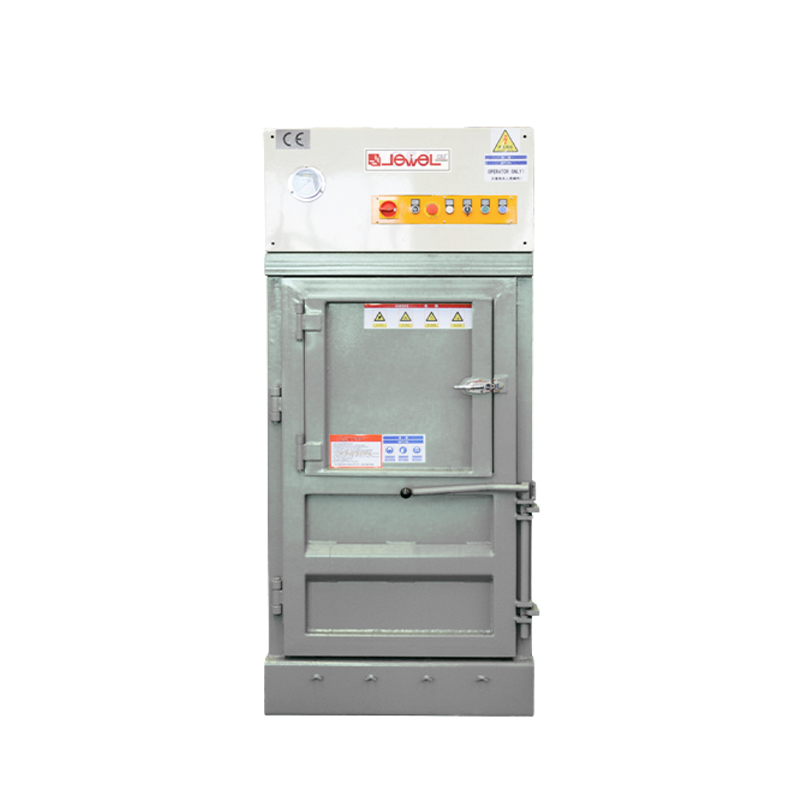
A vertical plastic baler is a machine that uses hydraulic pressure to compress plastic materials into compact, uniform bales. The word "vertical" refers to the direction the ram travels — straight down from the top of the bale chamber. Material is loaded through a front or side door, the ram descends and applies force, and the compressed plastic is held in shape until it's tied off and ejected.
The core mechanism is hydraulic. An electric motor drives a hydraulic pump, which pushes pressurized fluid into a cylinder, extending the ram downward. Most vertical plastic balers operate at pressures ranging from 10 to 100+ tons of force, depending on the model and intended material. Once the bale reaches the desired density, the ram retracts, the operator ties the bale with wire or strapping, and the door opens for ejection.
It's a straightforward cycle — load, compress, tie, eject — but done consistently, it transforms a chaotic waste stream into a clean, revenue-generating output.
Understanding what's inside the machine helps with both operation and maintenance decisions:
| Component | Function |
|---|---|
| Ram / Platen | The steel plate that descends to compress material |
| Bale Chamber | The enclosed space where plastic is loaded and compressed |
| Hydraulic Cylinder | Converts hydraulic pressure into downward ram force |
| Electric Motor & Pump | Powers the hydraulic system |
| Control Panel | Allows the operator to start, stop, and monitor cycles |
| Baling Wire / Strapping Guides | Channels that help thread tie wire around the finished bale |
| Safety Door / Interlock | Prevents the ram from cycling while the door is open |
| Ejection System | Mechanism (manual or powered) to push the finished bale out |
Each of these components plays a direct role in cycle efficiency, bale quality, and operator safety. A weakness in any one of them — say, a worn hydraulic seal or a faulty door interlock — will affect the entire output.
Here's how a standard cycle works on a typical vertical plastic baler:
The entire cycle — from loading to ejection — typically takes 2 to 5 minutes, depending on material type, machine size, and operator experience.
This is a question that comes up frequently, especially for facilities evaluating equipment for the first time.
| Feature | Vertical Plastic Baler | Horizontal Baler |
|---|---|---|
| Ram Direction | Top-down (vertical) | Side-to-side (horizontal) |
| Footprint | Compact, small floor space | Large, requires significant floor area |
| Throughput | Lower (manual loading) | High (conveyor-fed, continuous) |
| Bale Tying | Manual or semi-auto | Fully automatic on most models |
| Upfront Cost | Lower | Significantly higher |
| Best For | Small to mid-volume operations | High-volume recycling or industrial facilities |
| Installation | Simple, minimal civil work | Often requires structural modifications |
| Operator Requirement | One person | Often requires dedicated staffing |
The vertical plastic baler wins on cost, simplicity, and space efficiency. A horizontal baler wins on throughput and automation. For the vast majority of retail stores, warehouses, and mid-size manufacturers, the vertical option is more than adequate — and far easier to justify on a budget.
Not all vertical plastic balers are built the same. Walk into a supermarket stockroom and you'll find a compact, single-phase machine tucked into a corner. Step into an industrial packaging facility and the vertical baler there might weigh several tons and run on three-phase power. The category is broader than most people assume — and choosing the wrong type for your operation creates problems that don't show up until you're already committed.
The most fundamental way to categorize a vertical plastic baler is by how much force the ram generates. This directly determines what materials it can process and how dense the resulting bales will be.
| Force Range | Classification | Typical Application |
|---|---|---|
| 5 – 20 tons | Light-duty | Small retail, offices, convenience stores |
| 20 – 50 tons | Mid-range | Supermarkets, warehouses, light manufacturing |
| 50 – 100 tons | Heavy-duty | Industrial facilities, recycling depots |
| 100+ tons | High-force industrial | Large-scale plastic processors, MRFs |
Higher tonnage doesn't always mean better — it means more force, which is only useful if your material requires it. Compressing PET bottles or LDPE film with a 100-ton machine when a 30-ton unit would do the job is an unnecessary cost. Match the force to the material and volume.
Side-Eject
The bale exits through a door on the side of the machine. This is the most common configuration for vertical plastic balers used in retail and warehouse environments. It requires clear floor space on one side of the machine for the bale to slide or roll out.
Front-Eject
Less common in smaller machines, but found in mid-to-large models. The bale exits through the front loading door. This can simplify placement in tight spaces where side clearance is limited, but it does mean you can't be standing directly in front when the bale comes out.
Bottom-Eject (Downstroke with floor exit)
Rare in true vertical configurations, but some hybrid designs push the bale downward onto a pallet or conveyor. Mostly seen in industrial setups where the baler is elevated on a platform.
Tying the bale is a step that's easy to underestimate — until your operator is doing it 15 times a day.
| Feature | Manual-Tie | Auto-Tie / Semi-Auto Tie |
|---|---|---|
| Bale tying method | Operator threads and ties wire by hand | Machine guides or automates the wire feed |
| Labor requirement | Higher | Lower |
| Machine cost | Lower | Higher |
| Cycle speed | Slower | Faster |
| Maintenance complexity | Simple | Moderate |
| Best for | Low-volume, budget-conscious operations | Medium to high-volume facilities |
For most small businesses processing a few bales per day, manual-tie vertical plastic balers are perfectly adequate. Once you're producing 10+ bales per shift, the labor savings from a semi-auto tie system start to make financial sense.
Open-End / Standard Chamber
The most common design. Material is loaded through a front door, compressed, tied, and ejected. Works well for loose plastics, bottles, and mixed packaging.
Closed-Door Compression
Some models compress while the door is fully sealed, which is better for lighter, bulkier materials like LDPE film or foam that would otherwise push back out of the chamber during the ram stroke. It creates a cleaner, more uniform bale.
Extended-Chamber Models
Taller bale chambers allow for larger bale volumes before tying is needed. This is useful when processing lightweight materials that take up a lot of volume before reaching sufficient bale weight. Extended chambers reduce the frequency of tying and ejection cycles.
Floor space is often the deciding factor in equipment selection, especially in retail environments where every square meter has a cost.
| Machine Class | Approx. Footprint (W × D) | Bale Weight (Plastic) | Typical Power Supply |
|---|---|---|---|
| Compact / Light-duty | 0.8m × 1.0m | 40 – 100 kg | Single-phase 220V |
| Mid-size | 1.0m × 1.3m | 100 – 200 kg | Single or Three-phase |
| Full-size | 1.2m × 1.5m | 200 – 350 kg | Three-phase 380V |
| Industrial | 1.5m × 2.0m+ | 350 – 600 kg | Three-phase, high-draw |
Note that footprint doesn't tell the whole story — ceiling height matters too. A vertical plastic baler with a tall frame and an upward-opening ram housing may require 3.5 to 5 meters of clearance. Always check the machine's full open height, not just its standing height, before committing to a location.
Most vertical plastic balers use a single ram — one cylinder, one platen, one compression stroke. This is reliable, easy to maintain, and sufficient for the majority of plastic waste types.
Some specialized vertical balers use a two-stage compression system, where a pre-press function partially compresses the load before the main ram applies full force. This is particularly useful for very light, voluminous materials like shrink wrap or foam where a single stroke would push material sideways rather than compress it effectively.
For standard operations dealing with bottles, rigid containers, or mixed soft plastics, a single-ram vertical baler is the right choice in nearly every case.
One of the most common questions facilities ask before purchasing a vertical plastic baler is straightforward: what can actually go in it? The answer is broader than most people expect — but there are real limits, and ignoring them leads to damaged equipment, contaminated bales, and rejected loads at the recycling facility.
PET is the material most people picture when they think about plastic recycling — water bottles, soda bottles, juice containers. It's also the material that a vertical plastic baler handles most efficiently.
PET compresses well, holds its shape in a bale, and has strong resale value on the recycling market. Bales of clean, sorted PET consistently attract buyers. The main considerations are:
For most operations, PET bottles represent the cleanest, most straightforward material to run through a vertical plastic baler.
HDPE covers a wide range of everyday plastic packaging — milk jugs, detergent bottles, shampoo containers, buckets, and crates. It's slightly harder and more rigid than PET, but compresses effectively under the hydraulic force of a mid-range or heavy-duty vertical baler.
This is where things get more nuanced. LDPE film — the thin plastic used in stretch wrap, shopping bags, shrink wrap, and bread bags — is one of the most common plastic waste streams in retail and warehouse environments. It's also one of the trickiest to bale.
The challenge is density. Film is extremely light and voluminous. Without proper compression, a bale of film will spring back, lose its shape, or come untied. Tips for processing LDPE film effectively:
| Material | Compression Difficulty | Recommended Baler Tonnage | Market Value |
|---|---|---|---|
| PET Bottles | Low | 20 – 50 tons | High |
| HDPE Rigid | Low–Medium | 30 – 60 tons | Medium–High |
| LDPE Film | Medium–High | 30 – 60 tons (closed door) | Medium |
| Shrink Wrap | High | 40 – 80 tons | Low–Medium |
| PP Containers | Low–Medium | 20 – 50 tons | Medium |
| PS Foam (EPS) | Very High | Specialist only | Low |
| PVC | Medium | 30 – 60 tons | Low |
PP is used in yogurt tubs, bottle caps, straws, packaging trays, and woven bags. It's a relatively stiff material that compresses predictably and produces firm, well-shaped bales. Recycling demand for PP has grown steadily, making it a worthwhile material to separate and bale rather than throw into general waste.
Woven PP bags (common in agricultural and industrial supply chains) can also be baled but tend to interlock and create uneven bale shapes — pre-flattening or cutting them before loading helps.
Rigid PS (think disposable cutlery, CD cases, certain food containers) can be processed in a vertical plastic baler, though its recycling market is limited in many regions. The bigger issue is EPS foam (expanded polystyrene — the white foam used in packaging). EPS has almost no density even after compression. A standard vertical baler will compress it somewhat, but the bales will be light, bulky, and difficult to sell without specialist processing. EPS is better handled by a dedicated foam densifier rather than a standard vertical plastic baler.
PVC appears in pipes, flooring, window profiles, and some packaging films. A vertical plastic baler can compress PVC, but it comes with caveats:
Many facilities use their vertical plastic baler for more than just plastic. Cardboard is the most common secondary material — and most vertical balers handle it without issue. Some machines are specifically rated for both plastics and cardboard, which is useful for retail environments generating both waste streams.
Other materials that can typically be processed:
This part matters. Putting the wrong material into a vertical plastic baler doesn't just damage the machine — it can create safety hazards and render entire bales unsaleable.
| Material | Reason to Exclude |
|---|---|
| Hazardous chemical containers | Residue poses safety and contamination risk |
| Pressurized canisters / aerosols | Serious explosion risk under compression |
| Glass | Shatters, damages the bale chamber and ram |
| Metal scrap / sharp objects | Damages the ram face and hydraulic seals |
| Wet or liquid-filled containers | Adds dead weight, promotes mold, degrades bale quality |
| EPS foam (in standard balers) | Poor compression, near-zero bale density |
| Medical or biohazard waste | Regulatory and safety violation |
| Electronics / e-waste | Contains hazardous materials, not suitable for compression |
Training operators on exclusions is just as important as training them on the machine itself. One aerosol can in the wrong load is a serious incident waiting to happen.
A vertical plastic baler isn't a niche piece of equipment reserved for large recycling operations. It's working quietly in the back of grocery stores, on the loading docks of distribution centers, inside food processing plants, and in the waste rooms of hotels. The range of industries using this equipment is wider than most people assume — and the reasons each sector adopts it tend to be slightly different.
This is probably the single largest market for vertical plastic balers. A mid-size supermarket generates a substantial daily volume of plastic waste — shrink wrap from pallets, stretch film, plastic packaging from produce and meat departments, and rigid containers from the stockroom. Left unmanaged, this waste takes up enormous space in compactors or skip bins and generates high collection costs.
A vertical plastic baler changes that equation. Staff can feed waste into the machine throughout the day during natural breaks in workflow. By end of shift, there are several tied bales ready for collection — or better yet, ready to be sold back to a recycler.
What makes vertical balers particularly well-suited to retail:
For supermarket chains operating multiple locations, standardizing on the same vertical baler model across sites simplifies staff training, maintenance contracts, and bale logistics.
Distribution centers move product constantly — which means they also move enormous quantities of plastic packaging. Stretch wrap, shrink film, pallet covers, and plastic banding all accumulate at high volume, often faster than waste management systems can handle.
In this environment, a vertical plastic baler is typically positioned near the unloading dock, where packaging is removed from incoming pallets. Operators integrate baling into the unloading workflow rather than treating it as a separate task — packaging comes off, goes straight into the baler, and the cycle continues.
| Challenge | How a Vertical Baler Helps |
|---|---|
| High daily film volume | Converts loose film into dense, stackable bales |
| Limited dock space | Compact footprint frees up floor area vs. loose bins |
| Labor efficiency | One operator, simple cycle, minimal time per bale |
| Waste collection costs | Fewer collections needed, lower hauling fees |
| Sustainability targets | Supports diversion-from-landfill reporting metrics |
Larger distribution centers sometimes operate two or three vertical balers positioned at different points in the facility rather than routing all waste to a single central location — this reduces handling time and keeps workflow moving.
Manufacturing environments generate plastic waste in forms that are often more varied and harder to manage than retail — off-cuts, rejected parts, packaging waste, production film, and defective products all enter the waste stream simultaneously.
A vertical plastic baler in a manufacturing context is often used as a first-stage solution: sorting waste by plastic type, baling each type separately, and staging bales for collection by material-specific recyclers. This approach maximizes the resale value of each bale and keeps contamination low.
Industries within manufacturing that commonly use vertical plastic balers:
The key distinction from retail use is volume and variety. Manufacturing facilities often need heavier-duty machines — 50 tons or above — and benefit from models with larger bale chambers to reduce cycle frequency during high-output production runs.
Material Recovery Facilities (MRFs) and independent recycling centers are, in some ways, the most demanding users of a vertical plastic baler. These operations process high volumes of mixed or pre-sorted plastic daily, and equipment reliability is non-negotiable — downtime directly translates to missed revenue.
In smaller or regional recycling operations, vertical balers are preferred over horizontal models for specific material streams where throughput requirements don't justify the capital cost of a full horizontal line. A vertical baler handles sorted plastics — separated by resin type — efficiently and produces bales that are easy to weigh, label, and load onto trucks for downstream processors.
Typical setup in a small-to-mid recycling operation:
The hospitality sector generates more plastic waste than most guests would ever guess. Amenity packaging, food delivery containers, bar and kitchen film, and laundry packaging all accumulate daily across large hotel and resort properties.
For hospitality operators, the case for a vertical plastic baler is as much about space and cleanliness as it is about recycling economics. Loose plastic waste in a hotel kitchen or receiving area creates hygiene concerns and takes up space that has better uses. A baler consolidates that waste quickly and keeps waste areas orderly.
Hospitality-specific considerations:
These two sectors share a common challenge: plastic waste that may be contaminated or subject to strict hygiene regulations. In both cases, the vertical plastic baler is used selectively — for clean plastic packaging waste rather than for clinical or food-contact waste.
In food processing plants, clean film, trays, and packaging materials from the intake side of production can be baled without issue. In healthcare settings, outer packaging from medical supplies — boxes, shrink wrap, pallet covers — is appropriate for baling, while anything that has been in contact with clinical waste is handled through separate regulated channels.
| Sector | Appropriate Baling Materials | Materials to Exclude |
|---|---|---|
| Food Processing | Clean intake film, shrink wrap, rigid containers | Food-contaminated packaging, mixed wet waste |
| Healthcare | Outer packaging, pallet wrap, clean rigid containers | Clinical waste, biohazard materials, sharps packaging |
| Hospitality | Kitchen film, delivery packaging, amenity wrappers | Wet organic waste mixed with plastic |
Buying a vertical plastic baler without a clear selection framework is how facilities end up with a machine that's either underpowered for their volume, too large for their space, or incompatible with their electrical supply. The market offers enough variety that there's almost certainly a right fit for your operation — but getting there requires asking the right questions before you start comparing models.
This is the foundation of every other decision. Before looking at any machine specifications, spend a week tracking how much plastic waste your facility generates — by weight if possible, by bin volume if not.
| Daily Plastic Waste Volume | Recommended Baler Class |
|---|---|
| Under 100 kg/day | Light-duty compact baler (5–20 tons) |
| 100 – 300 kg/day | Mid-range baler (20–50 tons) |
| 300 – 600 kg/day | Heavy-duty baler (50–100 tons) |
| 600 kg+/day | Industrial baler or consider horizontal |
If your volume sits right on the border between two categories, go with the higher-capacity machine. Running a baler at 70–80% of its rated capacity consistently is far better for longevity than pushing a smaller machine to its limits every day. Overworked hydraulic systems wear faster, and replacement costs will outpace any savings made on the initial purchase.
Also consider seasonal variation. A business that doubles its plastic output during peak season needs a machine rated for peak volume, not average volume.
A vertical plastic baler has three critical dimensions — footprint, standing height, and fully open height. Most buyers check the first two and forget the third. The ram housing on many vertical balers extends upward when the machine is in its raised position, and if your ceiling is lower than the machine's full open height, you have a problem that can't be solved after delivery.
Practical checklist for space assessment:
A machine that's inconvenient to reach is a machine that doesn't get used consistently.
Not all plastic is equal under compression. The material type you're primarily processing should directly influence your tonnage selection and chamber configuration choice.
| Primary Material | Minimum Recommended Force | Chamber Type |
|---|---|---|
| PET bottles | 20–30 tons | Standard open-end |
| HDPE rigid containers | 30–50 tons | Standard open-end |
| LDPE film / stretch wrap | 30–50 tons | Closed-door preferred |
| Mixed rigid plastics | 40–60 tons | Standard open-end |
| PP woven bags | 30–50 tons | Extended chamber preferred |
| Mixed soft & rigid | 50–80 tons | Closed-door or extended |
If your facility generates multiple plastic types, prioritize the most difficult material when selecting tonnage — the machine needs to handle your hardest job, not just your easiest one.
This is a detail that catches buyers off guard more often than it should. Vertical plastic balers are available in both single-phase and three-phase configurations, and the wrong choice means either an expensive electrical upgrade or a machine that simply can't be powered at your site.
| Power Type | Typical Availability | Suited For |
|---|---|---|
| Single-phase 220–240V | Residential, small commercial | Light-duty balers, retail environments |
| Three-phase 380–415V | Industrial, large commercial | Mid to heavy-duty balers |
Before finalizing any purchase, have your electrician confirm: available phase configuration at the installation point, maximum amperage draw the circuit can support, and whether a dedicated circuit is needed for the baler. Some mid-range vertical balers are available in both single and three-phase versions — worth checking if your power supply is a limiting factor.
A baler produces bales. Those bales need to go somewhere — stored on-site until collection, loaded onto trucks, or moved to a designated recycling area. How you handle bales after they leave the machine is part of the selection equation.
| Baler Class | Typical Bale Weight (Plastic) | Handling Method |
|---|---|---|
| Light-duty | 40–100 kg | Manual handling possible |
| Mid-range | 100–250 kg | Pallet jack recommended |
| Heavy-duty | 250–400 kg | Forklift required |
| Industrial | 400–600 kg | Forklift essential |
Purchase price is the number most buyers focus on. It shouldn't be the only one. A vertical plastic baler that costs less upfront but requires frequent maintenance, produces inconsistent bale quality, or lacks spare parts availability can cost significantly more over a three-to-five year period than a better-specified machine purchased at a higher initial price.
| Class | Typical Purchase Price Range |
|---|---|
| Light-duty compact | $3,000 – $8,000 |
| Mid-range | $8,000 – $20,000 |
| Heavy-duty | $20,000 – $45,000 |
| Industrial | $45,000 – $100,000+ |
When evaluating ROI, factor in: reduction in waste collection frequency and hauling fees, revenue from bale sales to recyclers, labor time saved vs. handling loose waste, and any rebates or incentives available through local recycling programs. For many mid-size retail or warehouse operations, a well-chosen vertical baler pays for itself within 12 to 24 months purely through reduced collection costs — before accounting for any recycling revenue.
Don't overlook this, especially if you're operating in a regulated industry or exporting equipment across borders. Key certifications to look for:
A machine without appropriate certification for your region may create insurance liability issues, fail workplace safety audits, or be ineligible for certain recycling program incentives. Always confirm certification status before purchase, not after.
A vertical plastic baler is a relatively straightforward piece of hydraulic machinery — but "straightforward" doesn't mean maintenance-free. The facilities that get 10 to 15 years of reliable service from their machines are almost always the ones that treat the maintenance schedule seriously from day one.
| Daily Check | What to Look For | Action if Issue Found |
|---|---|---|
| Hydraulic fluid level | Fluid at correct level on sight glass | Top up with manufacturer-specified fluid |
| Hydraulic fluid appearance | Should be clear or amber, not milky or dark | Milky fluid indicates water contamination — investigate immediately |
| Visible leaks | Check cylinder, hoses, fittings, and tank | Tag out machine, identify and fix leak source |
| Ram face condition | Look for cracks, deformation, or buildup | Clean surface, report any structural damage |
| Door interlock function | Confirm ram won't cycle with door open | Do not operate if interlock fails — report immediately |
| Emergency stop | Quick test to confirm it halts the cycle | If unresponsive, take machine out of service |
| Bale chamber | No foreign objects, no material buildup on walls | Clear chamber before starting first cycle |
| Control panel | No warning lights, error codes, or unusual sounds | Investigate any abnormal indicator before proceeding |
Lubrication
Most vertical plastic balers have grease nipples on the ram guides, door hinges, and ejection mechanism. Weekly greasing of these points reduces friction, prevents premature wear on sliding surfaces, and keeps the machine operating smoothly under load. Use the grease type specified in the machine manual — substituting a different grade can actually cause more harm than no grease at all.
Wire guide inspection
The channels through which baling wire is threaded take wear every cycle. Check for burrs, deformation, or buildup of plastic residue that could snag the wire during tying. A wire that catches mid-tie and snaps under tension is both a production interruption and a safety hazard.
Hydraulic hose inspection
Run your hand along accessible hydraulic hoses and check visually for: cracking or brittleness in the outer sheath, bulging (which indicates internal pressure weakening), chafing where hoses contact the machine frame, and weeping at fittings or crimped ends. A hydraulic hose failure under pressure is not a minor event. Replace any hose showing visible deterioration before it fails, not after.
Electrical connection check
Vibration from normal operation gradually loosens electrical connections over time. A weekly visual check of the control panel wiring, motor terminals, and sensor connections takes two minutes and prevents intermittent faults that are frustrating and time-consuming to diagnose.
| Monthly Task | Detail |
|---|---|
| Hydraulic fluid quality test | Check viscosity and contamination level — replace if degraded |
| Filter inspection and replacement | Hydraulic return filter collects particulates — replace per manufacturer interval |
| Ram seal inspection | Look for weeping around the cylinder rod — early sign of seal wear |
| Pressure gauge check | Confirm operating pressure matches manufacturer specification |
| Structural bolt torque check | Vibration loosens fasteners — check frame and mounting bolts |
| Safety guard integrity | Confirm all guards are undamaged, correctly positioned, and secured |
| Bale chamber wall inspection | Look for cracks, wear, or deformation from repeated compression cycles |
| Motor condition | Check for unusual heat, vibration, or noise during operation |
Fluid is not a set-and-forget item
Hydraulic fluid degrades over time through oxidation, thermal cycling, and contamination. Most manufacturers recommend a full fluid change every 2,000 operating hours or annually, whichever comes first. Operating with degraded fluid accelerates pump wear and can cause valve sticking.
Contamination is the primary killer
More hydraulic system failures are caused by contamination than by any other factor — dirt, water, and metal particles circulating through the system damage pump internals, valve seats, and cylinder seals. Keep the hydraulic tank filler cap clean, always use clean containers and funnels when topping up fluid, and replace filters on schedule without exception.
Operating temperature matters
A hydraulic system running too hot — typically above 60°C — degrades fluid rapidly and accelerates seal wear. If your machine feels unusually hot to the touch near the hydraulic tank or pump, or if cycle times are increasing, elevated temperature may be the cause. Check the fluid level, filter condition, and whether the system is being overworked relative to its rated capacity.
| Symptom | Likely Cause | Recommended Action |
|---|---|---|
| Slow or sluggish ram movement | Low fluid, clogged filter, worn pump | Check fluid and filter first; test pump pressure |
| Ram not reaching full stroke | Pressure relief set too low, internal leak | Check relief valve setting; inspect cylinder seals |
| Unusual noise from pump | Cavitation (low fluid) or pump wear | Check fluid level immediately; assess pump condition |
| Bales inconsistent in density | Uneven loading or pressure fluctuation | Review loading technique; check pressure gauge |
| Hydraulic fluid on floor | Hose, fitting, or seal failure | Tag out machine and locate leak source before next use |
| Control panel error codes | Sensor fault, electrical issue, overload | Refer to machine manual; contact technician if unresolved |
| Excessive vibration during cycle | Loose mounting bolts or worn ram guides | Check and torque all frame fasteners; inspect guides |
In-house maintenance covers a lot of ground, but there are situations where a qualified service technician is the right call:
Trying to repair hydraulic components without the right tools, knowledge, and clean working conditions typically makes the problem worse and can create safety risks. Build a relationship with a qualified baler service provider before you need one — finding someone reliable in an emergency is harder and more expensive than having a contact already in place.
The sections above cover the core knowledge around selecting, operating, and maintaining a vertical plastic baler. But there are always questions that fall between the categories — practical, specific, sometimes overlooked details that matter a lot once you're actually dealing with the equipment day to day.
It depends on the material and the machine, but for most mid-range vertical plastic balers processing rigid plastics like PET or HDPE, a complete bale takes between 15 and 45 minutes of cumulative loading and compression time. That's not 15 minutes of continuous operation — it's the total time across multiple load-and-compress cycles as the chamber fills incrementally throughout a shift.
The compression cycle itself — ram down, compress, ram retract — typically takes 2 to 4 minutes per cycle. How many cycles are needed per bale depends on material density. Dense rigid containers might need 4 to 6 cycles. Lightweight film might need 10 to 15. Operators working efficiently alongside their normal duties can produce 3 to 8 bales per shift on a mid-range machine without it becoming a primary time burden.
| Machine Class | Approximate Bale Dimensions (W × D × H) | Typical Bale Weight (Plastic) |
|---|---|---|
| Light-duty | 700 × 500 × 500 mm | 40 – 100 kg |
| Mid-range | 1,000 × 700 × 700 mm | 100 – 250 kg |
| Heavy-duty | 1,200 × 800 × 1,000 mm | 250 – 400 kg |
| Industrial | 1,400 × 1,000 × 1,200 mm | 400 – 600 kg |
Bale height is variable — it's determined by how full the chamber is when tying occurs, not by a fixed mechanical stop. This means operators have some control over bale weight by deciding when to tie off. Heavier bales are generally more efficient for transport and storage, but must be within safe manual or mechanical handling limits for your site.
Yes — single-operator use is standard for virtually all vertical plastic balers in commercial and retail settings. The machine is designed for exactly this. One person loads material, initiates the compression cycle, ties the bale, and ejects it.
The tasks that require attention from a single-operator safety perspective:
| Service Level | Frequency | Who Performs It |
|---|---|---|
| Basic checks (fluid, leaks, interlock) | Daily | Trained operator |
| Lubrication and hose inspection | Weekly | Trained operator |
| Hydraulic filter, fluid quality, pressure check | Monthly | Operator or in-house maintenance |
| Full hydraulic fluid change | Annually or every 2,000 hours | Qualified technician |
| Comprehensive mechanical inspection | Annually | Qualified technician |
| Seal and cylinder inspection | Every 2 years or as symptoms arise | Qualified technician |
A machine that follows this schedule and operates within its rated capacity should run reliably for 10 to 15 years before requiring major component replacement.
Genuinely, yes — provided the business generates enough consistent plastic waste to justify the investment. The threshold most equipment advisors use is roughly 50 to 80 kg of plastic waste per day. Below that, collection costs may not be high enough to generate meaningful savings, and the machine sits idle too often to pay for itself within a reasonable timeframe.
For small businesses above that threshold — independent supermarkets, small manufacturers, regional wholesalers, busy food service operations — a light-duty compact vertical plastic baler in the $3,000 to $8,000 range is a legitimate and financially sound investment. The footprint is small, the operating cost is low, and the collection savings often deliver payback within 18 to 30 months. Leasing or financing options also make entry more accessible for smaller operations that can't absorb a large upfront capital cost.
| Feature | Vertical Plastic Baler | Waste Compactor |
|---|---|---|
| Primary output | Tied bales ready for recycling | Compressed waste in a container or skip |
| Material handling | Produces sellable/recyclable bales | Reduces volume for landfill or general waste |
| Revenue potential | Yes — bales can be sold to recyclers | No — compacted waste goes to disposal |
| Material sorting | Designed for sorted material streams | Typically handles mixed general waste |
| End destination | Recycler or reprocessor | Landfill or waste-to-energy facility |
| Environmental outcome | Supports recycling and diversion | Reduces collection frequency only |
In short: a compactor makes waste smaller so it's cheaper to throw away. A vertical plastic baler makes plastic recyclable so it has value. For any facility with a genuine recycling objective — or a desire to recover revenue from waste — a baler is the right tool. A compactor is a volume management solution, not a recycling solution.
It depends on the machine. Light-duty vertical plastic balers running on single-phase 220–240V can often plug into an existing commercial circuit with minimal modification. Mid-range and heavy-duty machines running on three-phase power require a dedicated circuit with appropriate amperage rating.
Before installation, confirm:
Budget $300 to $2,000 for electrical work depending on site complexity. Always use a licensed electrician — improper wiring on high-draw industrial equipment is both a safety risk and a potential insurance liability.
This is a practical question that doesn't always get answered at the point of purchase — and it should be sorted out before the machine is installed, not after you have a yard full of bales and no buyer.
Options for bale disposal and sale:
| Factor | Impact on Bale Value |
|---|---|
| Material purity | Single resin type commands highest price |
| Moisture content | Wet bales are discounted or rejected |
| Bale consistency | Uniform size and weight preferred by buyers |
| Resin identification | Correct labeling by plastic type builds buyer trust |
| Volume offered | Higher regular volumes attract better contract rates |
Recommended products
In the context of the global circular economy and efficient industrial waste utilization, metal resource recycling demands higher equipment performance. Whether...
READ MOREThe Short Answer First A production manager in a corrugated packaging plant recently showed me two photographs. The first was a wall of baled cardboard and pla...
READ MOREIn modern industrial waste management, volume reduction and density enhancement are key to efficient transport and resource circulation. As industrial productio...
READ MOREAgainst the backdrop of resource recycling and industrial emission reduction, efficient material compaction technology has become an indispensable link in many ...
READ MOREA scrap baler machine compresses loose scrap materials — metal, cardboard, plastic, or paper — into dense, uniform bales that are easier to store, transport, a...
READ MOREIn industrial manufacturing, material recycling, and urban waste management systems, solid waste volume reduction and resource utilization are core links to red...
READ MORE
Waste Types
Categories
 Custom Baling Press Machine Manufacturers